Midjourney prompts
Midjourney Anime & Illustration Prompt Cases: 12 Character Sheets, Cover Key Visuals & Anime Scene Templates (V8.1)
Midjourney.ing11 min read
Contents+
Using Midjourney for anime / illustration / anime-style art most often fails when you enable --raw and wash out the painted look, full-body character sheets get unstable hand and foot proportions, or style words fight each other (cel shading + thick paint + realistic photography all in one prompt). This article gives you 12 ready-to-adapt templates built for Midjourney V8.1, covering character sheets, bust portraits, cover Key Visuals, street scenes, and multi-style variants—with notes on when not to enable --raw and how to go SD→Run as HD for delivery.
If you are still building your prompt skeleton, start with Midjourney Prompt Tips: A Structure Built for V8.1; for a general scene library, see Midjourney Prompt Case Library: 10 Ready-to-Adapt V8.1 Scene Templates (which includes one anime character case—this article breaks anime work into a dedicated, swappable topic); for the same character across multiple images, pair it with Midjourney Image-to-Image & Image Reference: From One Reference Image to Controlled Delivery and Midjourney Portrait Prompt Cases: 12 ID-Style, Fashion Editorial & Character Lookbook Templates (V8.1).
Three Rules for Anime & Illustration Output
- Lock medium mood first, then write character details
Pick one primary direction amonganime-style/cel shading/watercolor illustration/thick paint—do not stack them all. Specific hairstyle, outfit, and pose beat stackingmasterpiece, best quality. - Illustration and anime-style work usually starts without
--raw
--rawweakens default aesthetic packaging—good for realistic product / architecture work; cel shading and illustration often need stylize preserved. If results feel too “photographic,” confirm Raw is off first, then raise--stylizeas needed. - Explore in SD, deliver in HD; series work uses SREF
V8.1 natively supports about 2K. Keep test runs in SD; lock the winner with Run as HD. For account / character series, use SREF / Moodboards to lock art direction. See Midjourney HD vs SD: Save Time and Cost with a Resolution Strategy and Midjourney Style Reference Complete Guide: How SREF and Moodboards Keep Series Visuals Cohesive.
The prompts below are English templates. You can write in Chinese too; the key is still “character / scene subject → framing → light and color → art medium → parameters”.
Case 1: Full-Body Character Sheet (Cel Shading)
Best for: Character design, standing character art, character profile cards
Suggested parameters: Do not enable --raw; --stylize 200–280; keep chaos low
anime-style character full body standing pose, clean linework, soft cel shading, detailed outfit design, simple gradient background, character sheet illustration --stylize 250How to adapt: Swap pose (three-quarter turn / walking); background can become white seamless; if hands and feet are unstable, switch to half-body, or add image reference to lock proportions.
Case 2: Bust Portrait / Character Headshot
Best for: Avatars, character design finals, social character headers
Suggested parameters: Higher stylize; write expression and hairstyle clearly
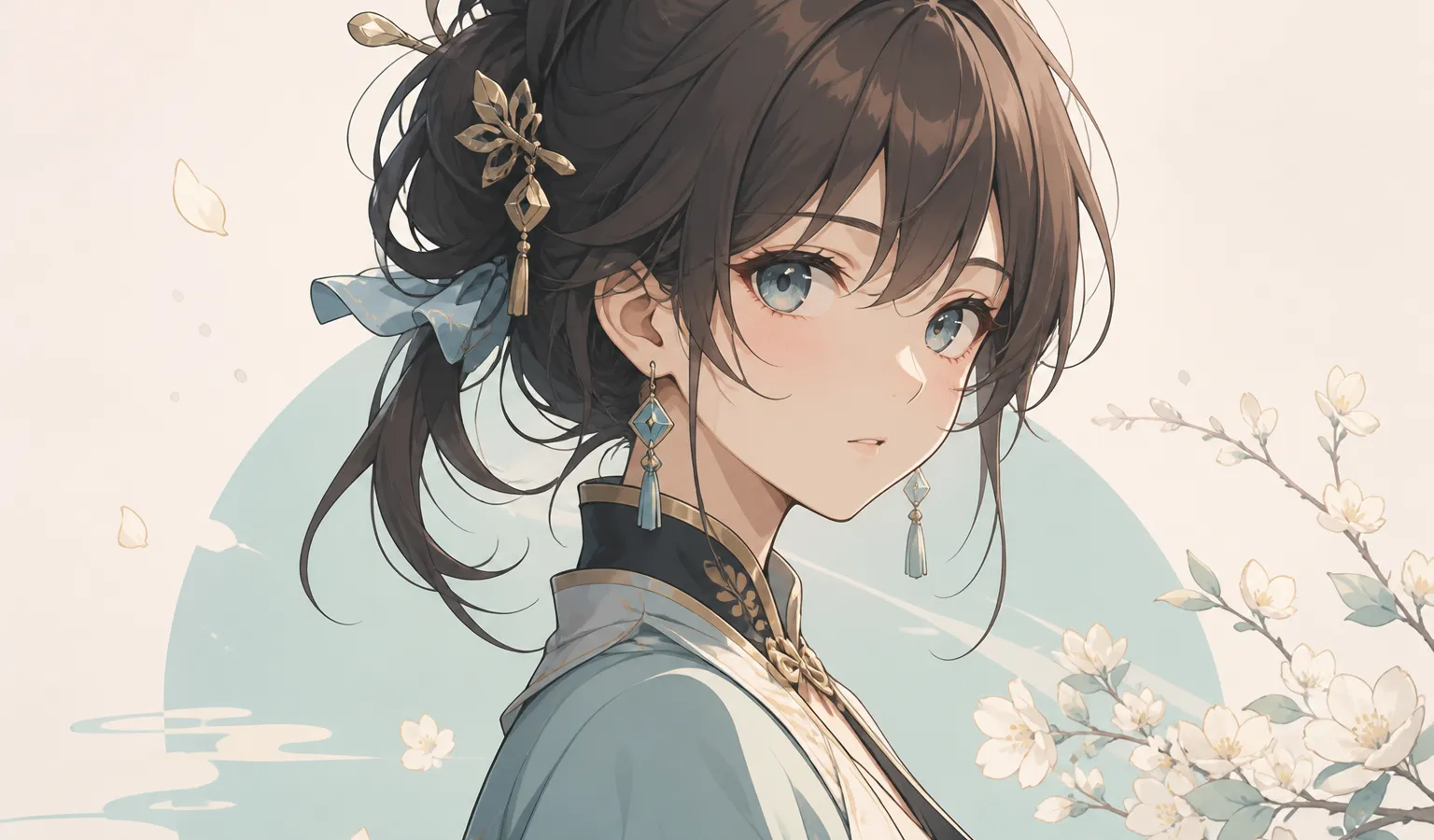
anime-style character bust portrait, clean linework, soft cel shading, expressive eyes, detailed outfit collar, pastel background, key visual illustration --stylize 250How to adapt: Replace cel shading with soft watercolor or thick paint illustration; change only hairstyle or expression per run—not both at once.
Case 3: Cover Key Visual (Character + Scene)
Best for: Novel / game covers, campaign Key Visuals, PV still-frame feel
Suggested parameters: Medium–high stylize; exploration can briefly raise --chaos, then lower after picking a winner
anime key visual of a heroine on a cliff above glowing city lights at dusk, dynamic three-quarter pose, dramatic rim light, vivid complementary colors, polished anime poster illustration --chaos 20 --stylize 220How to adapt: Swap protagonist design and scene; if poster feel is weak, add poster composition, title-safe negative space; lower chaos before final delivery.
Case 4: Rainy Neon Street Character
Best for: Urban anime, cyber-adjacent anime, atmospheric character art
Suggested parameters: Do not enable Raw; write colored light specifically; avoid literal “photography” stealing the frame
anime-style character standing on a rainy neon street, full body, cel shading, vivid cyan and magenta lights, detailed outfit design, clean linework, key visual illustration --stylize 250How to adapt: Change outfit and hair color; swap cel shading for soft watercolor; after account visual is fixed, attach SREF.
Case 5: School Slice-of-Life Half-Body (Soft Palette)
Best for: Youth-oriented stories, everyday anime tone, light-novel illustration
Suggested parameters: Medium–high stylize; use soft daylight
anime schoolgirl half-body portrait under soft afternoon sunlight, gentle smile, sailor uniform details, clean lineart, soft cel shading, airy pastel palette, slice-of-life illustration --stylize 230How to adapt: Swap uniform and season; background can add classroom window bokeh; for more “illustration book” feel, try soft watercolor.
Case 6: Fantasy Mage Full Body (Readable Props)
Best for: Fantasy character design, card art, world-building characters
Suggested parameters: Write one main prop and sigil clearly per run
anime fantasy mage full body with glowing staff, flowing cloak, ornate embroidery, soft magical rim light, clean linework, cel shading, fantasy character illustration --stylize 240How to adapt: Swap class (swordsman / archer); keep only one main prop; if effects pile up, remove particle overload type words and use subtle magical glow.
Case 7: Mecha Pilot + Cockpit (Human and Machine in Frame)
Best for: Mecha anime stills, character-and-vehicle relationship shots
Suggested parameters: Clarify human vs machine priority; keep chaos low
anime mecha pilot sitting in cockpit, medium shot through canopy glass, interface reflections, detailed pilot suit, sharp linework, soft cel shading, sci-fi anime illustration --stylize 230How to adapt: Swap mecha style; for “full mecha body,” open a separate template—do not cram cockpit close-up and full mecha into one sentence.
Case 8: Thick Paint Character Illustration (Non-Cel)
Best for: Concept illustration, painterly covers, non-line-art anime look
Suggested parameters: Explicit thick paint / oil illustration; usually still without --raw
thick paint illustration of a traveler in a windy mountain pass, strong brush texture, rich color blocks, dramatic sky, character-focused composition, painterly key art --stylize 200How to adapt: Swap subject; if results lean photographic, check whether Raw was enabled by mistake and emphasize illustration, brush strokes visible.
Case 9: Watercolor Landscape Scene (Environment-First)
Best for: Illustration landscapes, chapter opener pages, soft anime backgrounds
Suggested parameters: Put medium words early; character can be minimal or omitted
soft watercolor anime landscape of a quiet shrine path in spring, cherry blossoms, gentle washes, paper texture, airy negative space, illustration background art --stylize 210How to adapt: Swap season and location; to add a character, use small figure walking away—one figure action only.
Case 10: Chibi / Super-Deformed Expression Set
Best for: Stickers, merchandise, light character extensions
Suggested parameters: Explicit chibi / super-deformed; write proportions clearly
chibi anime character set of three expressions, big head small body, clean linework, flat cel colors, white background, sticker sheet illustration --stylize 220How to adapt: In practice, split into multiple generations (1–2 expressions each) is more reliable; use image reference for the same face to avoid drifting features per image.
Case 11: Manga Panel Still (Ink Lines + Screentone)
Best for: Storyboard practice, black-and-white manga pages, narrative stills
Suggested parameters: Explicit manga panel / screentone; can lower stylize slightly to keep line art crisp
black and white manga panel of two characters arguing in a hallway, bold ink lines, screentone shading, speed lines, dramatic close-up, manga illustration --stylize 160How to adapt: Swap conflict and framing; for color manga pages, remove black and white and use colored manga page.
Case 12: Same Character Three-Image Set (Sheet + Bust + Scene)
Best for: Character packs, submission materials, character launch triplets
Suggested parameters: Shared hairstyle and outfit words; art direction via SREF; face via image reference
same anime character set: (1) full body standing cel-shaded, (2) bust portrait expressive eyes, (3) rainy neon street key visual, consistent face and outfit, clean linework, anime illustration series --stylize 240How to adapt: In practice, split into three generations (one image each) is more reliable—keep character nouns and reference image fixed, change only framing and scene. Iteration: Midjourney Vary & Remix: Small-Step Iteration to Final Delivery; personal taste: Midjourney Personalization in Practice: Train and Apply Your Aesthetic Profile.
Character Sheet / Cover / Art Style: Which Template to Pick
| Goal | Prefer | Template bias | Parameter bias |
|---|---|---|---|
| Character sheet, profile card | Full body, clean background | Cases 1, 6 | No Raw; high stylize |
| Avatar / character design final | Half-body bust | Cases 2, 5 | Write expression and hairstyle clearly |
| Cover / Key Visual | Character + scene + compositional negative space | Cases 3–4, 7 | Light chaos during exploration |
| Non-cel illustration | Thick paint / watercolor medium words | Cases 8–9 | Emphasize illustration |
| Stickers / storyboard panels | Lock proportions and medium | Cases 10–11 | Split generations for stability |
| Character triplet set | Same design, different framing | Case 12 | SREF + image reference |
Turn Templates into a Deliverable Workflow
| Step | What to do | Purpose |
|---|---|---|
| 1 | Pick character sheet / cover / art-style template | Reduce stacking empty quality words |
| 2 | Replace only character and one outfit / prop item | Quick direction check |
| 3 | Generate candidates in SD; keep medium words single | Lock art direction |
| 4 | Confirm --raw is off; adjust --stylize as needed |
Preserve illustration feel |
| 5 | Same character, multiple images: image reference + short prompt | Stabilize face and identity |
| 6 | Series: attach SREF / Moodboards | Unified account visual |
| 7 | Vary Subtle for hands, fabric folds, and line art | Small-step refinement |
| 8 | Run as HD for ~2K delivery | Publish-ready output |
End-to-end flow: Midjourney AI Art from Start to Finish: The Complete 2026 Workflow (V8.1); lock shape with image reference: Midjourney Image Reference in Practice: Controlled Variants from Reference Images.
Why Anime Prompts Break When You Edit Them
- Stacking cel shading, thick paint, and realistic photography → torn art direction
- Illustration task with
--rawenabled by mistake → leans photographic, weaker line art - Starting in HD for trial and error → expensive and slow (V8.1: use SD→HD)
- Copying V7’s
--q→ V8.1 / V8.2 do not support--q - Full-body sheet: changing hairstyle + outfit + scene + effects in one go → impossible to review what worked
- Want the same character but rewrite the face every image → drift without reference / SREF
Full parameter table: Midjourney V8.1 Parameter Cheatsheet: –hd –raw –chaos –stylize; beginner pitfalls: 10 Common Midjourney Beginner Mistakes (and How to Fix Them).
How This Fits With Other Site Content
- Structure method: Midjourney Prompt Tips: A Structure Built for V8.1
- General 10-scene library: Midjourney Prompt Case Library: 10 Ready-to-Adapt V8.1 Scene Templates
- Portraits (including illustration character finals): Midjourney Portrait Prompt Cases: 12 ID-Style, Fashion Editorial & Character Lookbook Templates (V8.1)
- E-commerce / food / architecture cases: Midjourney E-Commerce Prompt Cases: 12 Product Hero & Lifestyle Scene Templates (V8.1), Midjourney Food & Restaurant Prompt Cases: 12 Menu, Plating & Atmosphere Templates (V8.1), Midjourney Architecture & Interior Prompt Cases: 12 Scheme Drawings, Moodboards & Night View Templates (V8.1)
- Series art direction: Series Visuals with Style Reference: Brand Consistency in Midjourney
Once you have character design ready (hairstyle, outfit, one main prop), enter the workspace from “Try Midjourney now” at the top: run Case 1 for a full-body sheet, Case 3 or 4 for cover / street scene, then Run as HD—faster to deliver than debating a “complete anime prompt encyclopedia.”
Closing
Midjourney anime and illustration prompts succeed when you lock medium mood first, then write character and scene. Use these 12 V8.1 templates to separate character sheets, character design finals, cover Key Visuals, and watercolor / thick paint / manga variants—and build the habit of “illustration without Raw first, SREF for series, image reference for the same character”—so your anime art / illustration / character sheets stay near deliverable instead of random wallpaper. Start by swapping the first character description in whichever template matches your current need.